


Local Lifestyle, News

Birding along the Cacapon reveals diversity of species

by Peter Wood

Editor’s note: This is part of a series appearing throughout the year about the creatures, plants and people in and around the Cacapon River.

The Cacapon River watershed is a marvel. A wonder, full of life in the steep forested hillsides, the wavy grass pastures and the open hay fields. Meandering roads and tranquil rivers bring visitors into a variety of landscapes that make the watershed home to many wild and wonderful birds.

“I got my passion for birds from my mom, who had been birding since the ‘50s,” said Rich Bailey, West Virginia Division of Natural Resources State Ornithologist. “One of my favorites you’ll find up and down the Cacapon River is the belted kingfisher.”

Seeing a kingfisher dive into the river for its lunch is pure excitement.

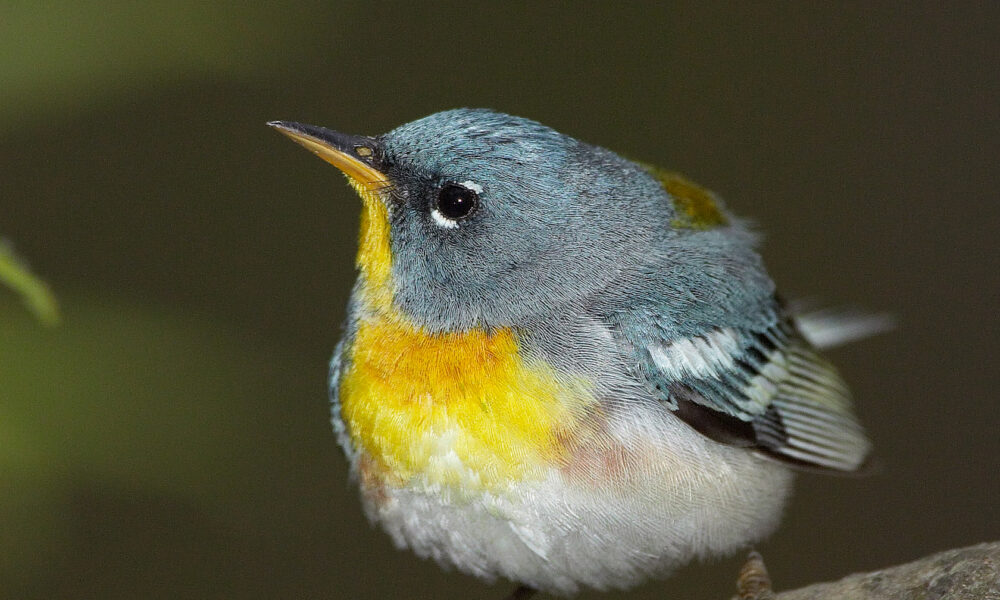
“There are birds that will nest in riparian habitats, the trees lining the river, species like Northern parula, which is a tiny little warbler,” Bailey said. “A keystone forest species is the wood thrush, known for its fluting, beautiful song. And then there is the cerulean warbler, which is often found up on the ridges.” Prairie warblers in the young forests and Eastern meadowlarks and the grasshopper sparrows in the meadows are also favorites in the Cacapon watershed.

This tiny little warbler, the Northern parula, can be spotted along the banks of the Cacapon River. (Photo credit: Wilbur Hershberger)

“Folks come to the Eastern Panhandle from the DC area because they know there are a lot of habitats that have a lot of birds,” Bailey said. Like the Bald Eagle and West Virginia’s biggest nesting duck, the common merganser.

“The common merganser is a beautiful, elegant duck,” Bailey said. “The males have an emerald green head with an orange bill and black and white on their backs. The female is a bit more drab, but they still have a distinctive brown crest.” While this duck has greatly increased in population over the past 25 years, many other birds still require urgent conservation efforts.

“We are focused on improving forest habitat based on the State Wildlife Action Plan to benefit migratory and forest songbirds,” Bailey explained. “In addition to research projects, we also support private landowners managing for wildlife on their properties.”

Broadly, WVDNR is engaging with residents across the state, getting them motivated and active in various ways for bird conservation.

The poster child for successful bird conservation is the Bald Eagle.

“We are closing in on 200 bald eagle nests documented in the state,” Bailey said. “Many are found in the Cacapon River watershed.”

Bald eagles were once endangered across the nation, but have rebounded with conservation efforts. In West Virginia, the rebound started with a nesting pair of bald eagles spotted in 1981 in The Trough, a 6-mile-long wooded gorge carved by the South Branch of the Potomac River.

The northern bobwhite quail has sadly disappeared from West Virginia, mostly due to the loss of the habitat they need to successfully breed and survive. Currently, WVDNR conservation efforts are focused on Eastern whip-poor-will, cerulean warbler, golden-winged warbler and wood thrush.

“Whip-poor-wills need a lot of good woods to nest in and open areas or young forests to forage,” Bailey explained. “West Virginia lacks much of the young forests needed for that habitat diversity.”

The lack of understory in the woods is also a problem. Over-browsing by white-tailed deer in many areas has greatly reduced the native forest understory.

“One of the key conservation actions that people can take is to allow hunting on their properties,” Bailey explained. “That can be a cultural challenge. People love to see deer, but the effect of overpopulation is a badly degraded habitat.” Improving forest habitat takes dedication from conservation professionals working with landowners.

“We work closely with USDA’s Natural Resources Conservation Service (NRCS) biologists on wildlife management on private land,” Bailey said. “NRCS provides cost-share assistance to landowners for habitat management efforts.” Landowners can reach out directly to their local NRCS office for more information.

“Working together with landowners, federal agencies and the residents across West Virginia is benefiting our bird populations, and there’s definitely a lot of opportunity in the Cacapon River watershed,” he emphasized.

For visitors and residents alike, the beauty of the river is joyous, and the birds, turtles, fish and mammals are an important part of the river scene. Because of Bailey and his colleagues at WVDNR and their tireless efforts, there is ready help to enhance and protect the Cacapon River watershed.

On Saturday, May 17, the Friends of Cacapon River is hosting a free birding walk with Dr. George Constantz, author of “Hollows, Peepers, and Highlanders.”

Learn more and RSVP at cacaponriver.org.

Did you know?

The Cacapon River watershed includes three major river segments: the Lost River, the North River and the Cacapon River. It’s a 112-mile journey from the river’s headwaters through farmlands, residential communities and forested hillsides to join the Potomac River just beyond Great Cacapon. The Lost and Cacapon are actually the same river. The Lost River begins south of Mathias, flowing north until it “Sinks” under some large rocks into a subterranean passage. The river emerges as the Cacapon River a few miles downstream. Eventually, the Cacapon River joins the Potomac River. The North River is the major tributary and meets the Cacapon at the Forks of Cacapon (Rt. 127 and Gaston Road). Together, these three rivers drain 680 square miles as it travels through Hardy, Hampshire, and Morgan counties.

Peter Wood is a board member of the Friends of the Cacapon River, whose mission is to preserve, protect, and promote the environmental health and scenic character of the Cacapon River and its watershed.

Facebook

Weather

BERKELEY SPRINGS WEATHER