by Geoff Fox
After the Civil War ended, the United States military entered numerous skirmishes and battles out west with various Indian/Native American. One is more well-known than the others.
That was the Battle of Little Big Horn, also known as Custer’s Last Stand.
The battle, which took place in June of 1876 in Montana, was between the U.S. government and the Lakota Sioux who, under the leadership of chief Sitting Bull, refuse to return to the reservation the government created for Indian tribes. The U.S. would recruit other Indian tribes who were traditional enemies of the Lakota to assist in the campaign. Lakota are assisted by allied tribe Cheyenne.
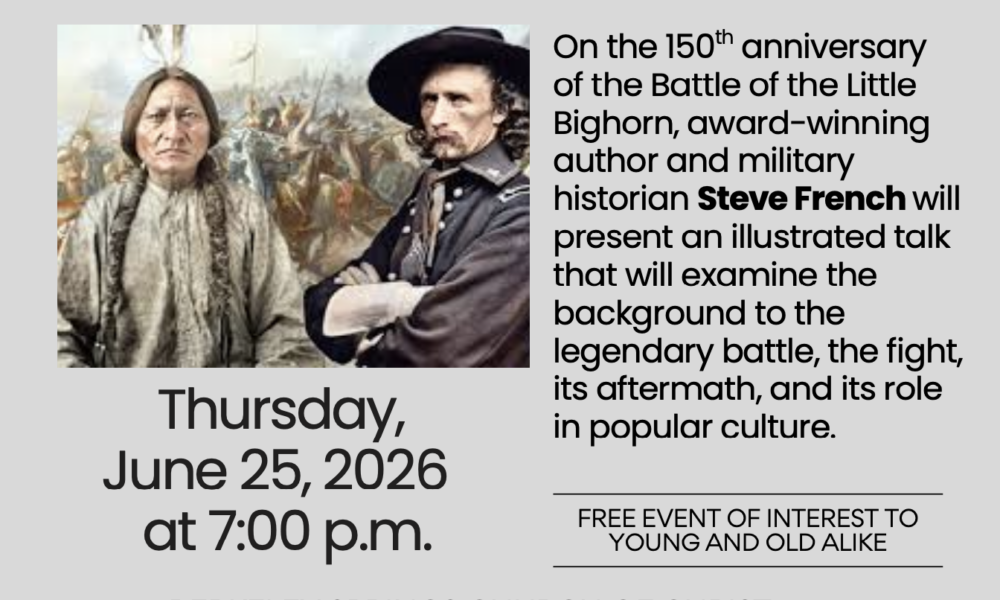
On Thursday, June 25, 150 years after the famous battle, local historian Steve French will be presenting a free, illustrated talk about the battle at the Berkeley Springs Church of Christ located at 290 S. Green Street, at 7 p.m.
This talk rounds up a lifelong interest in the famous 1876 battle in Montana.
French’s interest in the Battle of Little Big Horn goes back to when he was 9 years old and living in Michigan in the 1960s.
He said there was a store there that had an old Budweiser print of the battle. After moving to the Cherry Run area a year later, he received his first book about the battle.
French said Viola Weigel gave him the book The Day Custer Fell as a present for his tenth birthday.
The book tells the story of the battle from the Indian point of view, he said, adding he still has that book all these years later.
Over the years, French has spoken about the battle on many occasions at different events.
Since it’s the 150th anniversary of the battel, French thought it would be the right time to have it.
“It’ll be the only one in West Virginia, I’m sure,” French said.
The program itself, French said, would run about 45 minutes and then as much time as allowed for questions.
He’ll be going over the main participants from the calvary, such as George A. Custer, and from the Indian side; the campaign itself, which French said was a three-prong campaign; and then the battle itself for about 15 minutes; and finish up with the aftermath. 
Custer’s wife Elizabeth “Libby” Custer, brought his reputation up as she would write books and defend her husband’s name.
There will also be discussion about the battle and George Custer in pop culture like prints and how they influenced things, movies, and differences between those made in the 1940s and 1950s and those made more recently, and of course all the books written on the battle and Custer.
The reason this particular battle stands out in American history is because of the characters involved in the battle.
Of course, there was Custer himself who had been at several Civil War battles including Gettysburg. His brothers Thomas and Boston, Marcus Reno, James Calhoun, Sitting Bull, Crazy Horse, and Rain in the Face were all key figures in the historic event.
French said there were a number of soldiers and officers who had been in the Civil War, some even serving alongside Custer, who were also part of the Battle of Little Big Horn.
“You got some of these larger-than-life characters in there,” French said.
French said he hasn’t been to Little Bighorn yet, but he would like to get there.
“If I go there, I’m going first class, though!” he said with a laugh.
French said he has prints of the battle, including the one from Budweiser, and 30 or more books about the battle, most of which are primary sources from those who were serving at the battle as well as Indian accounts of the clash.
French said he would like to encourage people to bring their kids, especially if they’re interested in history as there will be people who will know this battle up and down.
French’s 150th anniversary remembrance of the Battle of Little Bighorn is free and will be held Thursday, June 25, at the Berkeley Springs Church of Christ located at 290 S. Green Street in Berkeley Springs.
French will also have his Civil War books available for sale at the event as well.


