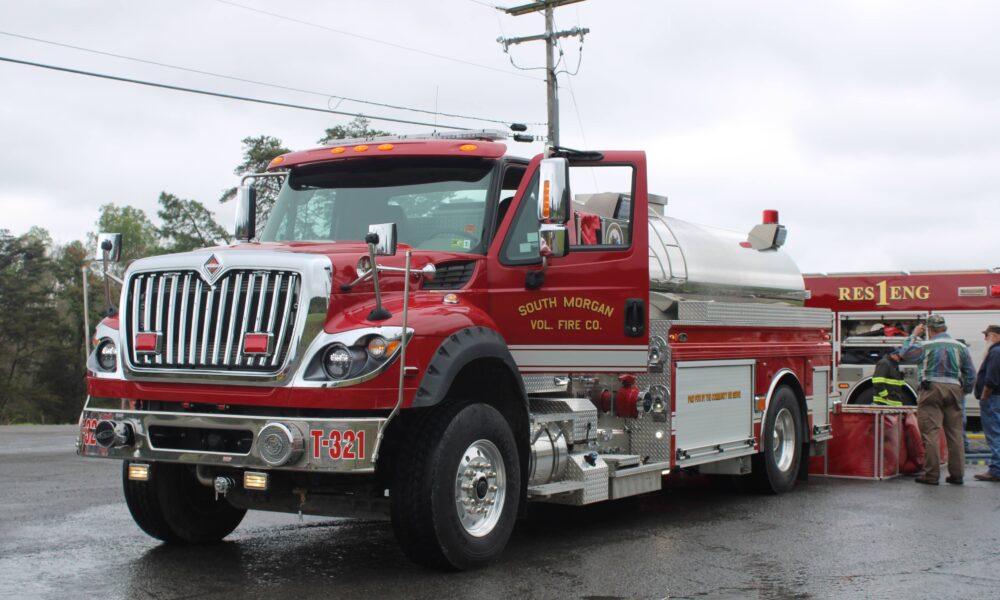
Six fire companies, include all four of Morgan County’s fire agencies, gathered for an all-day training session on Sunday, April 26 that covered techniques of moving large quantities of water in a rural setting for a coordinated emergency fire response.
Berkeley Springs Volunteer Fire Company and South Morgan Volunteer Fire Department co-hosted the event, with South Morgan’s station serving as the training launch point.
Participating in the training was Berkeley Springs, South Morgan, Great Cacapon Volunteer Fire Company, Paw Paw Volunteer Fire Company, Hancock Fire Department and Back Creek Valley Fire Department.
The majority of training took place at Morgan County’s Business Park along U.S. 522 south of Cacapon State Park, with multiple portable folding tanks staged at the end of the access road, and draft sites established along fresh water sources nearby.
Firefighters practiced their drafting skills, using soft-sleeved hoses to draw water from streams or other fresh water sources on Oakland Road and Fish Hathery Road to fill tankers.

Tankers then returned to the staging area to dump water into the folding tanks, which held 2,000 to 3,000 gallons each. Firefighters used jet siphons to move water among the containment tanks and to Great Cacapon’s ladder truck, flowing 1,000 to 1,300 gallons per minute to simulate an active fire response.


South Morgan fire officials chose fresh water sources for the training and avoided static water sources like ponds and lakes due to recent drought conditions, protecting those water sources for emergency use.
Throughout the day, volunteer firefighters maintained a tanker shuttle, a continuous cycle where tankers fill at remote water sources then deliver water to a fire scene when they are miles from pressurized fire hydrants.
Training also focused on the use of different-sized connections and equipment among the cooperating agencies, so that they became familiar with each other’s apparatus and capabilities.
Regular training on equipment setup, tanker shuttles and pump operations minimizes water loss at active fire scenes and identifies equipment needs in a controlled setting.
South Morgan Fire Chief Mark Miller estimated that more than 10 pieces of apparatus moved 150,000 gallons of water during the training exercise.

Roughly 35 volunteers completed the all-day training. South Morgan provided the lunch for trainees.
Fire officials plan to have more joint training exercises in the future as a way to build skills and a cooperative regional fire response.


